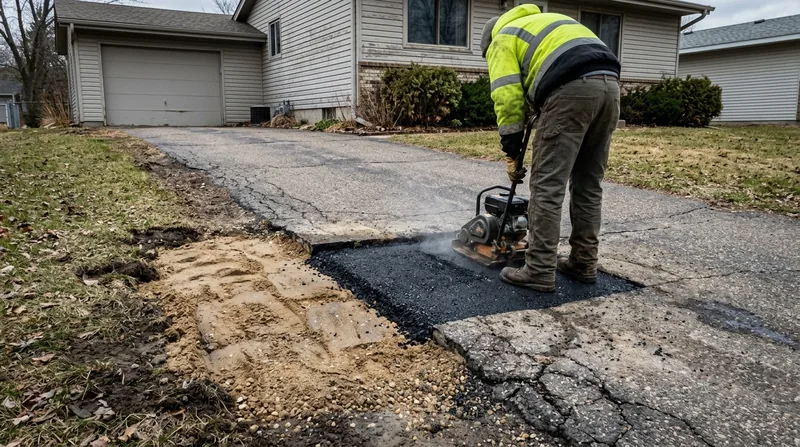




Driveway repair in St. Cloud means fixing edges that fail in the sandy glacial outwash along the river terraces, and patching frost heave and plow damage across the granite uplands where the till sits heavier. St. Cloud's driveways live in a deep frost zone where the spring thaw softens every base, winter heave lifts edges and cracks them, and plow blades chew the perimeter every season. We cut back to sound asphalt, rebuild the base where frost or damage has broken it, and patch flush with hot mix. The work is straightforward, the money is real, and the difference between a repair that holds and one that fails in two years is how deep you go and what you put underneath. This page covers what fails, why it fails, and how to tell the difference between a patch that makes sense and a resurfacing or replacement that does not.
Why Driveway Repair Matters in St. Cloud and Stearns County
The sandy outwash that underlies the river terraces near downtown St. Cloud and St. Cloud State drains fast but shifts under a driveway slab once the spring thaw sets in. Move up onto the till uplands and the old granite quarry ground around the edges of the Granite City, and you find the mid-century ranch belt with single asphalt drives poured decades ago that are now due for a mill and overlay. Stearns County sits in a deep frost zone, and the 42-inch footing depth that governs foundations here also governs what a driveway base has to survive: frost heave every winter, a wet spring thaw that softens everything underneath, and plow blades that chew the edges along every curb and apron. A driveway edge that fails in March is not a cosmetic problem; it is a structural failure that spreads inward and softens the base, and fixing it while it is still an edge is the difference between a $600 repair and a $4,000 resurfacing.
- Edge failure in sandy outwash happens because water penetrates under the slab, frost heaves it, and the freeze-thaw cycle breaks the bond between asphalt and base.
- Plow damage on the north and east sides of driveways is seasonal and predictable; catching it in spring before the base softens saves the entire slab.
- Base failure under the full width of the drive means the asphalt is sinking and cracking; that job needs resurfacing or replacement, not a patch.
- A repair that is cut back to sound material and patched over a rebuilt base will hold; a patch over a soft or damaged base will fail again next winter.
The key to a durable repair is understanding what is broken underneath and fixing it before the asphalt goes back down.
Key info: In Sartell and Sauk Rapids, where the clay till holds water differently than the river sand, a driveway base that is six inches deep in one neighborhood will fail faster in another because the soil drainage is not the same. The repair is the same; the cause is different. Getting a local contractor who knows the ground matters.
For more information on permitting and local requirements, check the City of St. Cloud building department website before you start any work that involves a driveway apron or a curb cut.
How We Repair Driveways in St. Cloud: A Step-by-Step Approach
Driveway repair in Stearns County starts with a clear look at what is broken and why. We measure the failed area, probe the base to understand the soil and drainage, and determine whether the asphalt above is still sound or whether the damage has spread. If it is an edge failure or a localized pothole, we cut back to sound material, remove the failed base, replace it with compacted stone or recycled asphalt base, and patch the asphalt flush. If the damage is extensive, we recommend asphalt resurfacing or overlay instead, because throwing patches at a base that is gone is wasted money. We give you a written estimate with tonnage and thickness so you know what you are paying for.
- We inspect the failed area and probe the base to understand the soil type and whether water is trapped underneath.
- We cut back the asphalt to sound material, removing all failed and soft sections down to solid ground.
- We remove and replace the base with compacted stone or recycled asphalt, proof rolling it to ensure it is solid.
- We patch the asphalt with hot mix, compacting it flush with the surrounding drive so water does not pond on the repair.
- We clean up and leave the site ready to use; new asphalt must cure for six to twelve months before you seal it.
The repair holds because the base is right, not because we are lucky.
Example: A ranch home in St. Cloud near the river with a twenty-year-old driveway had a three-foot edge failure on the north side where water had been running off the roof. We cut back the asphalt, removed eight inches of soft base, replaced it with compacted recycled asphalt base, and patched it with hot mix. Cost was under $900. The repair is holding because the base was the problem, not the asphalt.
Driveway Repair Methods: Patch, Resurfacing, and When to Replace
| Approach | Description | Best for |
|---|---|---|
| Pothole and Edge Patch | Cut back to sound asphalt, rebuild the base, patch with hot mix. Takes one day. | Single failures, edge breaks, localized damage under 15 percent of the surface. |
| Full-Depth Patch | Remove all asphalt and base in the failed area, rebuild from the subgrade up, patch the surface. Takes one to two days depending on size. | Deep potholes, areas where the base is completely gone, failures under parked vehicles or wheel paths. |
| Asphalt Resurfacing and Overlay | Mill the top layer or mill and remove the entire slab, grade and compact the base, lay new asphalt. Takes two to four days for a residential drive. | Multiple failures across 30 to 60 percent of the surface, alligator cracking, extensive edge damage, or when the existing base is still sound. |
| Full-Depth Replacement | Remove the entire driveway, excavate and grade the subgrade, rebuild the base to specification, lay new asphalt. Takes three to five days for a residential drive. | Base failure, settlement, poor drainage, or when resurfacing would not hold because the ground underneath is unstable or the slope is wrong. |
The honest question is always: will a patch still be here in two years? If the base is soft or if the damage covers more than thirty to forty percent of the surface, the answer is no. Resurfacing or replacement is the better money.
Driveway Repair Cost in St. Cloud: What to Expect
Driveway repair in St. Cloud starts at around $450 for a small edge patch or pothole, and moves up from there based on the size of the failed area, the depth of the damage, and what the base looks like once we cut into it. A three-foot edge failure or a two-by-three-foot pothole on a residential drive typically costs $600 to $1,200 because we are cutting back, removing and replacing base material, and patching with hot mix. If the base is soft or if the failure is larger, the cost moves toward $1,500 to $2,500. A driveway with multiple failures across thirty to forty percent of the surface is no longer a repair job; it is a resurfacing or overlay project and the cost depends on the square footage and the base condition.
What moves the price up is access (a tight driveway in Sartell or St. Joseph costs the same per square foot as an open drive in St. Cloud, but takes longer because we cannot bring the full crew in), the depth of the base failure (if we have to go down fourteen inches instead of eight, the material cost and labor time both increase), and whether Minnesota 811 has to locate utilities before we dig (it is required by law if we are doing a full-depth patch, and it is free). We give you a written estimate with tonnage and base specifications so you know exactly what you are paying for and what will be underneath the new asphalt. For a detailed pricing breakdown and to schedule a free estimate, call us at (320) 281-0372 or visit our full pricing page.
The cheapest repair is the one that does not fail again next winter. That means getting the base right, not cutting corners on depth.
Driveway Repair Near Me: What St. Cloud Homeowners Should Know When Hiring a Contractor
Hiring the right contractor for driveway repair in St. Cloud, Sauk Rapids, Sartell, or any of the surrounding communities means checking three things: whether the contractor is local and verifiable, whether they give you a written estimate with tonnage and depth, and whether they explain what is broken and why. The single strongest trust signal in this trade is being verifiably local, because the historic fraud in driveway paving is the itinerant door-to-door pitch with out-of-state plates, no written contract, and a price that is too good to be true. We have been in St. Cloud since 2009, our trucks carry local plates, and we give every customer a written estimate with materials and thickness specified. Ask any contractor for at least two other estimates before you decide, check their references with people who had work done in the last two years, and never pay a large cash deposit upfront.
- Verify that the contractor is fully insured and ask for a certificate of insurance before work starts.
- Get a written estimate that includes the size of the repair area, the depth of the base replacement, and the tonnage of material being used.
- Understand whether a driveway apron or curb cut requires a permit from your city; St. Cloud, Sauk Rapids, and Sartell all have different rules, so ask your local building department before you commit.
- If you live in an HOA community, check the architectural guidelines to confirm that asphalt repair or resurfacing is approved before you hire anyone.
- Never sign a contract that promises a lifetime warranty on asphalt; asphalt is a material, not a product, and an honest warranty covers workmanship for one to three years.
A good contractor will tell you when a repair makes sense and when you need resurfacing instead. That honesty is what keeps you from throwing money away.
Ready to get started? Contact us for a free estimate or call (320) 281-0372. We respond within 24 hours and we will answer your questions about what is broken and what it costs to fix it right.
Driveway Repair in St. Cloud: Pricing Guide
| Service | Price | Details |
|---|---|---|
| Small edge patch or single pothole | Starting at $450 | Includes cutting back to sound asphalt, base prep, and hot mix patch, typical area under 50 square feet |
| Medium edge failure or multiple potholes | Starting at $900 | Includes removal and replacement of base material, compaction, and patching, typical area 50 to 150 square feet |
| Large failure or full-depth patch | Starting at $1,500 | Includes complete removal of asphalt and base, subgrade inspection, rebuilt base, and new surface, area 150 to 300 square feet |
| Multiple failures across the driveway | On estimate | If damage covers more than 30 to 40 percent of surface, resurfacing or replacement is more cost-effective than patching |
| Travel and site visit | Included | No separate mileage fee or call-out charge within St. Cloud and Stearns County service area |
| Free estimate | No obligation | Written estimate with tonnage and thickness specifications, response within 24 hours at (320) 281-0372 |
Indicative pricing, the exact cost depends on square footage, finish, and site access. Free personalized estimate within 24h at (320) 281-0372.


