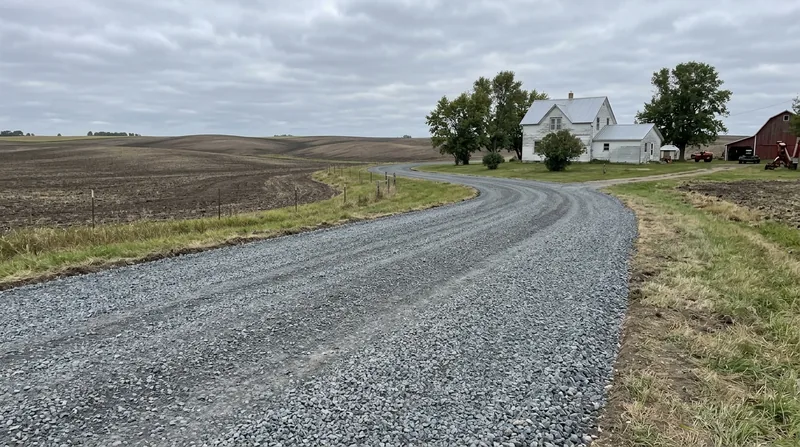




Gravel Driveway Installation & Grading in St. Cloud keeps rural and upland homes accessible through the spring thaw and beyond. The rolling till uplands around St. Cloud's granite quarry belt and the older ranch neighborhoods in Sartell and Sauk Rapids sit on heavy clay and glacial till that sheds water differently than the sandy river terraces downtown. A properly graded and compacted gravel drive sheds that water instead of turning to mud every April. We grade and compact crushed rock to slope the surface, build a solid base that won't shift under freeze-thaw cycles, and create drainage that handles Stearns County's deep frost zone and wet spring runoff. This is construction work that pays for itself in years of reliable access without the cost of asphalt.
Why Gravel Driveway Installation & Grading Matters in St. Cloud's Till Uplands
Gravel driveways work on the upland terrain around St. Cloud where the soil is till and clay, not the sandy outwash of the river neighborhoods. The till holds water differently than sand, and a driveway that is not graded correctly becomes a muddy channel every spring. Frost heave in Stearns County runs 42 inches deep, which means a driveway base has to survive that cycle year after year. A gravel drive that is properly sloped, compacted, and built on a stable subgrade stays solid through the thaw, sheds runoff, and costs far less than asphalt to install and maintain.
- Proper grading slopes the surface away from the property so water runs off instead of pooling.
- Compacted crushed rock base resists frost heave and stays stable under the freeze-thaw cycle.
- Drainage fabric and subgrade prep keep the driveway from turning to mud in spring thaw.
- Gravel is far cheaper to install than asphalt and holds up well on rural and upland lots.
A well-built gravel driveway in Sartell, Sauk Rapids, or the granite country around St. Cloud stays passable and looks intentional, not neglected.
Key info: Stearns County frost heave and spring thaw create the biggest challenge for gravel and unpaved drives. Grading that sheds water and a compacted base that resists frost movement are the difference between a driveway that lasts and one that turns to mud every April. Check with your city or township for any grading permits before work begins; many rural jurisdictions have drainage or culvert rules that apply to driveway work.
For more information on how base preparation affects long-term driveway performance, see our page on Asphalt Milling & Removal, where we explain the role of a solid subgrade in any driveway project.
How We Install and Grade Gravel Driveways in St. Cloud
Gravel driveway installation starts with understanding the lot, the soil, and the water flow. We begin by removing any existing material, grading the subgrade to slope away from structures, and preparing a stable base. We then lay compacted crushed rock in layers, each one proof-rolled to ensure it won't shift. The final surface is crowned slightly so water runs off to the sides, and we use the right stone size and type for your soil and climate. The whole job is measured in tons, not square feet, and every estimate specifies exactly what we are laying down and how thick it is.
- We remove old material and grade the subgrade to slope away from your home and structures.
- We lay a compacted base course of larger crushed rock to resist frost heave and provide drainage.
- We proof-roll the base to confirm it is stable and won't shift under a vehicle.
- We top with a smaller-stone finish course that is compacted and crowned for water shedding.
- We specify tonnage and stone type on your estimate so you know exactly what is going in.
A gravel driveway in St. Cloud or Sartell that is built this way stays solid through the winter and handles spring thaw without turning to mud.
Example: A 200-foot driveway on a lot in St. Joseph that slopes toward a culvert needs a 4-inch compacted base of 3/4-inch crusher run, a 2-inch finish layer of 5/8-inch stone, and a crown of 1/4 inch per foot. That is roughly 12 tons of material, graded and compacted. We measure it, quote it by tonnage, and the estimate tells you exactly what you are getting and why.
See our Driveway Extensions, Widening & Aprons page for information on how to handle culverts, drainage easements, and apron work that may overlap with gravel driveway grading.
Gravel Driveway Installation Methods & Materials
| Approach | Description | Best For |
|---|---|---|
| Compacted Crushed Rock | Two-layer system: compacted 3/4-inch base course and 5/8-inch finish course, proof-rolled and crowned for drainage. | Most upland and till-soil driveways in St. Cloud, Sartell, and Sauk Rapids; long-lasting and frost-resistant. |
| Recycled Asphalt Millings | Compacted reclaimed asphalt that binds together under traffic, creating a semi-solid surface that sheds water and resists frost heave. | Budget-conscious homeowners and rural lots; material is recycled and compacts over time; see our Recycled Asphalt & Millings Driveways page for details. |
| Gravel with Stabilizer Additive | Crushed rock mixed with a dust-control and binding agent that reduces washout and keeps the surface firmer longer. | Driveways on steeper slopes or in high-traffic areas where regular gravel would washout; reduces dust and maintenance. |
| Subgrade Grading & Drainage Only | We prepare and slope the existing soil or subgrade, compact it, and leave it ready for the homeowner to add gravel or choose another surface later. | Homeowners on a budget or those who want to add material in phases; ensures proper slope and frost protection foundation. |
Gravel Driveway Installation & Grading Cost in St. Cloud: What to Expect
Gravel driveway installation in St. Cloud starts at around $950 for a small, short drive with simple grading and modest material needs. Cost moves up based on driveway length, width, the depth and type of base required for your soil, site access, and how much existing material needs to be removed. A longer driveway on clay till that needs a thicker frost-resistant base, or one with difficult access, will cost more. We measure the site, calculate the tonnage needed, specify the material, and give you a written estimate with all the details. Getting two or three estimates from different contractors is always smart, and you should compare what each one is actually putting in, not just the total price.
- Driveway length and width are the first cost drivers; a 150-foot drive costs less than a 300-foot drive.
- Soil type and frost depth determine base thickness; clay till in Stearns County needs a thicker base than sandy soil.
- Removal of old material, debris, or poor subgrade adds cost but is often necessary for a solid result.
- Site access and equipment space affect how quickly we can work and what machinery we can use.
- Material choice matters; recycled asphalt millings cost less than virgin crushed rock but may not suit every site.
For a detailed breakdown of pricing and to see how other services fit into the overall cost of your driveway project, visit our full pricing overview. Every estimate is free and includes a specific tonnage breakdown so you know what you are paying for.
What to Look for When Hiring a Gravel Driveway Contractor Near St. Cloud
Hiring the right contractor for gravel driveway installation means checking that they are insured, getting multiple estimates, and understanding what they are actually putting in the ground. A reputable contractor will measure your driveway, walk the site with you, and give you a written estimate that specifies material type, tonnage, and base depth. Ask for references from recent jobs in St. Cloud or nearby towns, and call them to ask how the driveway is holding up. If your lot is in an HOA community or a township with specific grading or drainage rules, confirm that the contractor understands those requirements and will help you navigate any permits. Be cautious of any contractor who quotes a price without visiting the site, offers a deal that sounds too good, or won't put the estimate in writing.
- Verify that any contractor is fully insured and can provide a certificate of insurance on request.
- Get estimates from at least two contractors and compare what material and tonnage each one is specifying.
- Ask for references from homeowners in St. Cloud, Sartell, or Sauk Rapids and follow up with calls to verify recent work.
- Confirm that the contractor understands local permitting rules and any HOA architectural standards that may apply to your driveway.
- Avoid any offer that comes unsolicited, includes no written contract, or requires a large cash deposit upfront.
A local contractor who has been in business for years, knows the St. Cloud soil and frost conditions, and stands behind their work is your best choice. Contact us for a free estimate, and we will walk your site, answer your questions, and give you a clear, written price.
Gravel Driveway Installation & Grading in St. Cloud: Pricing Guide
| Service | Price | Details |
|---|---|---|
| Small gravel driveway (under 150 feet) | Starting at $950 | Includes subgrade grading, compacted 4-inch base, and 2-inch finish of crushed rock, measured and compacted |
| Medium driveway (150 to 250 feet) | Starting at $1,800 | Includes removal of old material if present, full subgrade prep, frost-resistant base, and finish course with crown for drainage |
| Large or complex driveway (over 250 feet or difficult access) | On estimate | Requires site visit to assess soil type, frost depth, access, and removal scope; written estimate with tonnage and material specifications provided |
| Recycled asphalt millings alternative | Starting at $750 | Lower-cost option using compacted reclaimed asphalt; ideal for budget-conscious homeowners and rural properties |
| Travel and site assessment | Included | No mileage fee or travel charge in St. Cloud and surrounding service areas; estimate visit is free and no-obligation |
| Free estimate | Free | Written estimate with material specs and tonnage within 24 hours; call (320) 281-0372 to schedule your on-site visit |
Indicative pricing, the exact cost depends on square footage, finish, and site access. Free personalized estimate within 24h at (320) 281-0372.


