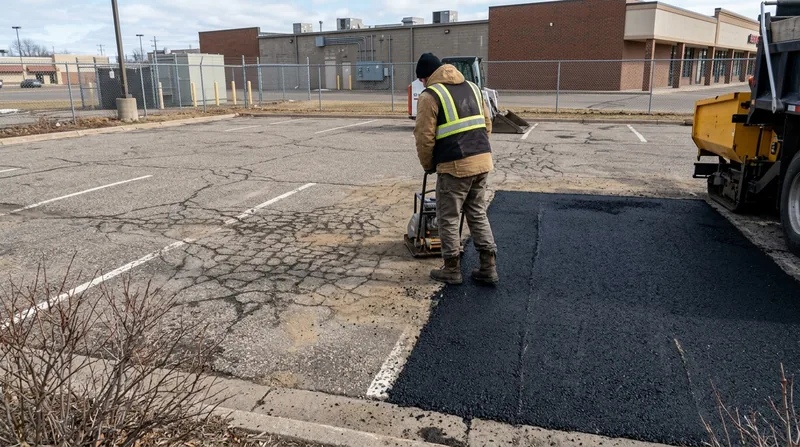




Parking Lot Repair & Resurfacing in St. Cloud means cutting out the failed asphalt, rebuilding the base where frost heave and salt have done their damage, and patching flush so the lot holds through the next plow season. Stearns County sits in a deep frost zone, and parking lots here crack and alligator over winter as the ground freezes and thaws, pushing the slab up and breaking it apart. The sandy glacial outwash that underlies much of St. Cloud and Sauk Rapids drains fast but washes out under repeated freeze-thaw cycles, leaving voids that cause the asphalt above to settle and fail. We remove the broken asphalt, rebuild the aggregate base, and reset the surface so your lot is safe, drains properly, and does not need a full replacement. This work is urgent in spring, when the damage from winter is visible and the paving season opens.
Why Parking Lot Repair Matters in the St. Cloud Frost Zone
Parking lots in Greater St. Cloud fail faster than in warmer climates because of frost heave. The 42-inch footing depth that governs building codes here also governs what a parking lot base must survive: the ground freezes solid in December, thaws in April, and shifts the asphalt slab upward and downward every winter. Salt and plow blades accelerate the damage. A parking lot that was solid three years ago can show alligator cracking across thirty percent of the surface by spring, especially if the base was never built to frost depth or if water has been pooling at the edges.
- Frost heave lifts the slab unevenly, creating stress cracks that spread under traffic.
- Salt and freeze-thaw cycles break down the asphalt binder, turning the surface into loose aggregate.
- Water infiltration through cracks softens the base and causes the slab to settle or dish.
- Plow blades chew the edges and corners, widening cracks and exposing the base to more water.
- Untreated cracks spread quickly because water and traffic work together to enlarge them.
Parking lot repair in St. Cloud is not optional once alligator cracking starts. The damage spreads, the base erodes, and a patch job that costs a few thousand dollars in May becomes a full replacement that costs ten times as much in August.
Key info: A parking lot in Sartell or St. Joseph with alligator cracking across more than thirty to forty percent of the surface needs base work and resurfacing, not patching. We cut out the failed section, inspect the base for washout, rebuild with compacted aggregate, and reset the asphalt flush so it bonds and holds through the next winter.
For guidance on permits and municipal requirements for parking lot work in your city, contact your local building department. St. Cloud Public Works handles permitting for work in the public right-of-way and can advise on setbacks and drainage requirements.
How We Repair and Resurface Parking Lots in St. Cloud
Parking lot repair starts with a walk-through inspection to measure the failed area and check the base. We cut out the broken asphalt in a clean rectangle or square, never leaving jagged edges that trap water. We then inspect the base: if it is solid and well-compacted, we simply reset the asphalt. If the base has washed out or settled, we excavate to frost depth, rebuild with compacted gravel and recycled asphalt base, and proof-roll it to confirm it is stable before we reset the top course. The new asphalt is set flush with the surrounding surface so water runs off and traffic does not catch an edge.
- We measure the failed area and take depth samples to understand what the base looks like.
- We cut out the broken asphalt cleanly, removing all debris and loose material.
- We inspect the base and excavate further if sand has washed out or the foundation is soft.
- We rebuild the base with compacted aggregate to frost depth, typically 42 inches in Stearns County.
- We proof-roll the base with a heavy compactor to confirm it will not settle under traffic.
- We set the hot mix asphalt in two courses, binder and surface, and trowel the edges flush.
- We allow 24 to 48 hours for the new patch to cool and set before traffic returns.
The result is a repair that holds because the base is solid and the asphalt is bonded. For larger lots with extensive cracking, we recommend asphalt resurfacing or overlay, which covers the entire lot and adds years of life without the cost of full replacement.
Real example: A small office park in Sauk Rapids had six patches in the lot, each one two to three years old and cracking again. Rather than patch each one separately, we milled the top two inches of asphalt across the entire lot and reset a new two-inch surface course. The job took two days, cost less than patching all six spots again, and gave the lot fifteen to twenty years of new life.
Parking Lot Repair Methods and When to Use Each
| Method | What It Involves | Best For |
|---|---|---|
| Pothole and Spot Patch | Cut out the damaged area, rebuild the base if needed, reset asphalt flush with the surrounding surface. | Single potholes or small areas of failure, less than fifty square feet. |
| Full-Depth Patch | Remove asphalt and base to frost depth, rebuild with compacted gravel and recycled asphalt base, reset the asphalt in two courses. | Areas where the base has washed out, settled, or shows signs of soft spots under the asphalt. |
| Mill and Overlay | Remove the top one to three inches of asphalt across the entire lot, reset a new surface course bonded to the existing base. | Lots with multiple cracks or alligator cracking across more than twenty percent of the surface, where patching would be repeated. |
| Full Replacement | Remove all asphalt and base, rebuild the base to frost depth, reset the lot in binder and surface courses. | Lots where the base is compromised across a large area, the lot is more than twenty-five years old, or alligator cracking exceeds forty percent. |
The choice between these methods depends on how much of the lot is failed, how deep the damage goes, and whether the base is solid. We assess the lot on site and recommend the method that gives you the best return on investment.
Parking Lot Repair & Resurfacing Cost in St. Cloud: What to Expect
Parking lot repair costs in St. Cloud start at around $650 to $1,200 for a small pothole or spot patch, depending on the size of the failed area and whether the base needs rebuilding. A full-depth patch on a larger area, twenty-five to fifty square feet, typically runs $2,500 to $4,500. A mill and overlay on a small lot, five thousand to ten thousand square feet, usually falls in the range of $3,500 to $6,500. Full replacement is quoted on site because it depends on the lot size, base condition, and local fill and equipment costs.
The main factors that affect price are the size of the failed area, whether the base has washed out and needs excavation and rebuilding, the depth of frost in your location, and how quickly you need the work done. A patch in spring, when demand is high, may cost more than the same patch in early fall. Getting two or three written estimates from local contractors is the best way to understand the range for your lot. Each estimate should include the area being repaired, the depth of base work, the tonnage of asphalt, and the timeline.
For a detailed breakdown of what drives cost in your specific situation, visit our pricing overview or call us at (320) 281-0372 for a free, no-obligation estimate.
Parking Lot Repair & Resurfacing Near Me: What to Look for When Hiring a Contractor in St. Cloud
Hiring a parking lot repair contractor is straightforward if you know what to verify. The strongest signal that a contractor is local and trustworthy is a local address, local phone number, and local plates on the trucks. Avoid unsolicited door-to-door offers, crews without a written contract, requests for large cash deposits up front, or prices that seem too good to be true. A legitimate contractor will give you a written estimate that includes the area being repaired, the depth of base work, the tonnage of asphalt, and the timeline. The estimate should be specific, not vague.
- Verify that the contractor is fully insured and can provide a certificate of insurance on request.
- Ask for references from recent parking lot repairs in your area and call at least two.
- Check whether your city or HOA requires a permit for the work and confirm the contractor will help navigate permitting.
- Request a written contract that specifies the scope, the materials, the timeline, and the total price.
- Confirm that the estimate includes base inspection and rebuilding if needed, not just the asphalt cost.
- Ask how long the repair is expected to last and what maintenance will keep it in good shape.
Minnesota does not require a state contractor license for single-skill paving work, but that does not mean paving is unregulated. Permits are required by your city for work in the public right-of-way or on curbs and aprons. Always check with your local building department or HOA before you book. Contact us for a free estimate and we will walk you through the permitting process for your location.
Parking Lot Repair & Resurfacing in St. Cloud: Pricing Guide
| Service | Price | Details |
|---|---|---|
| Spot Patch (Pothole) | Starting at $650 | Small failed area under fifty square feet, base inspection included, asphalt reset flush with surface |
| Full-Depth Patch | Starting at $2,500 | Twenty-five to fifty square feet, base excavation and rebuild to frost depth, two-course asphalt |
| Mill and Overlay | Starting at $3,500 | Five thousand to ten thousand square foot lot, top two inches milled and replaced, entire surface refreshed |
| Full Replacement or Large Repair | On estimate | Site inspection required to assess base condition, lot size, and frost depth before pricing is given |
| Free Estimate | No charge | Written estimate with tonnage and depth specs, response within 24 hours at (320) 281-0372 |
Indicative pricing, the exact cost depends on square footage, finish, and site access. Free personalized estimate within 24h at (320) 281-0372.


