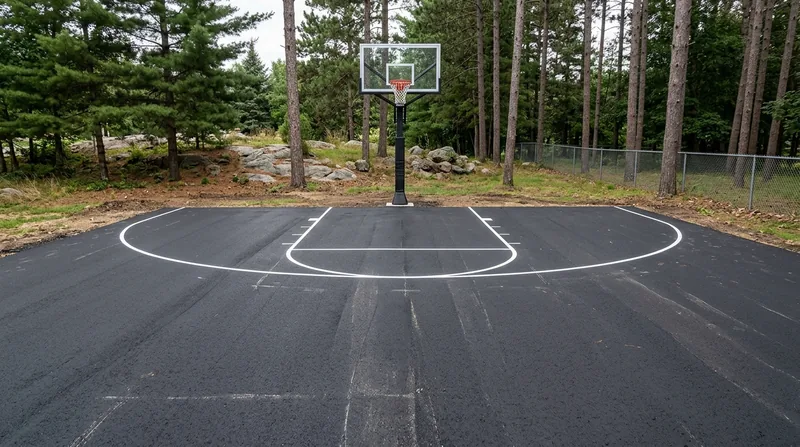




Sports Court & Path Paving in St. Cloud demands a base built to survive frost heave, not just a smooth playing surface. Stearns County sits in a deep frost zone where the ground freezes 42 inches down every winter, and the spring thaw softens everything underneath. A backyard basketball court, tennis court, or walking path that was paved over a thin or poorly compacted base will heave and crack by April, regardless of how well the asphalt itself was laid. We grade and pave courts and paths across Sartell, Sauk Rapids, and St. Cloud so the surface stays flat through the spring thaw and the freeze-thaw cycles that follow. The difference between a court that lasts and one that fails in two years is the base preparation, the tonnage of aggregate, and the proof rolling we do before the hot mix goes down.
Why Sports Court & Path Paving Matters in St. Cloud's Freeze-Thaw Climate
Greater St. Cloud's residential paving work spans sandy glacial outwash near the Mississippi River and heavier clay till uplands around the old granite quarry ground. Both soils behave differently in spring. The sandy terraces near downtown drain fast but shift under a driveway slab once the thaw sets in. The clay till uplands hold water longer and create different frost-heave pressures. A sports court built on either soil type without a proper aggregate base and compaction will fail within a season or two. The frost line here is deep, the thaw is wet, and the ground moves.
- We compact the base in lifts to 95 percent density using proof rolling, which identifies soft spots and weak zones before asphalt goes down.
- We size the aggregate base to the local frost depth and soil type, not to a generic national standard.
- We slope the court for drainage so water does not pond under the surface during the spring thaw.
- We specify the binder course and surface course thickness based on use (basketball generates different loads than a walking path) and the base conditions we find on site.
The result is a court that plays true year-round and lasts through multiple Minnesota winters without cracking, heaving, or developing the alligator cracking that signals base failure.
Key info: A homeowner in Sartell with a clay-based lot will see different drainage and frost behavior than one on the sandy terraces near St. Cloud State. We assess the soil and water movement on your property before we design the base, not after the court fails.
For more information on how proper base preparation prevents failure, see our guide to asphalt resurfacing and overlay, which covers the difference between a surface-level fix and a structural solution.
How We Build a Sports Court or Path That Lasts in St. Cloud
A sports court job starts with a site visit and measurement. We walk the property, check drainage, look at the soil and slope, and identify any utilities that need locating (Minnesota 811 is required by law before any excavation). We then remove any existing asphalt or debris, grade the subgrade to the correct slope, bring in the right aggregate base for your soil type, and compact it in lifts. Once the base is proof-rolled and approved, we lay the binder course and surface course to the thickness required for the use and the local frost conditions.
- We obtain a written estimate that specifies the aggregate tonnage, base depth, binder thickness, and surface course thickness so you know exactly what you are paying for.
- We verify all local permits with your city or village, as driveway aprons, curb cuts, and impervious-surface limits vary by municipality across Greater St. Cloud.
- We perform a site utility locate through Minnesota 811 before any digging begins, which is required by state law.
- We compact the base to 95 percent density using a vibratory roller and proof rolling, which identifies soft spots that must be reworked before asphalt is placed.
- We lay the asphalt in two courses (binder and surface) at the temperature and thickness required for your court use and local conditions.
- We allow the asphalt to cure for six to twelve months before you seal it, as new asphalt must cure fully before any sealer is applied.
The entire process, from grading to final rolling, ensures that your court will not heave or crack when the ground freezes and thaws.
Local example: A residential basketball court in Waite Park on clay till required 6 inches of compacted gravel base and a 2.5-inch asphalt surface to handle the frost depth and the concentrated loads of the posts and court play. The same court design on sandy soil near St. Cloud would have used 4 inches of base and 2 inches of surface, because the sand drains faster and does not hold water the same way.
For details on how we handle grading and base preparation for other projects, see our page on gravel driveway installation and grading.
Methods and Approaches for Court and Path Paving
| Approach | Description | Best for |
|---|---|---|
| Full-depth construction | Remove existing surface and base, grade subgrade, install new aggregate base, compact to 95 percent, lay binder and surface course to spec. | New courts on bare ground or sites with failed existing asphalt, clay or sandy soils requiring different base depths. |
| Mill and overlay | Remove the top 1.5 to 2 inches of existing asphalt, grade and compact the remaining base, lay new binder and surface course. | Courts with sound base and minimal cracking, where the existing aggregate is still stable and compacted. |
| Grading and new base only | Regrade an existing site to correct slope and drainage, remove soft or failed soil, install new aggregate base, compact and proof roll. | Paths or courts where the top asphalt is sound but the base is failing or drainage is poor. |
| Walking path paving | Lighter base and surface specification for pedestrian use only, graded for drainage, compacted and paved to 2 to 2.5 inches. | Residential pathways, park connectors, or HOA common areas where vehicle loads are not a factor. |
Sports Court and Path Paving Cost in St. Cloud: What to Expect
A residential basketball or tennis court in St. Cloud typically starts at $8,500 for a basic 2,000-square-foot court with a standard 4 to 6-inch aggregate base and 2.5-inch asphalt surface. Larger courts, courts on clay till that requires deeper base preparation, or courts in Sartell or Sauk Rapids where utilities or grading complexity adds cost will run higher. A walking path is less expensive per square foot because it carries lighter loads and requires a thinner surface. The factors that move the cost up are soil type (clay till requires more base and compaction than sandy soil), site slope and drainage (poorly sloped sites need regrading and possibly drainage work), existing asphalt or debris removal, and proximity to utilities or structures that require careful excavation.
Always get two or three written estimates that specify the aggregate tonnage, base depth, and asphalt thickness. A low-ball price that does not break down the base or tonnage is a red flag, because it usually means the contractor is cutting the base depth to hit a price rather than building to the frost and soil conditions on your property. Visit our pricing page for a detailed breakdown of costs by job type and the factors that affect your final quote.
Sports Court and Path Paving Near Me: What St. Cloud Homeowners Should Know When Hiring a Contractor
A sports court or path is an investment in your property, and the contractor you hire should be local, should provide a written estimate with tonnage and thickness specs, and should be fully insured. Ask for references from courts or paths they have built in the last two or three years, and drive by those sites if you can. Verify that the contractor is familiar with St. Cloud's frost depth and soil conditions, because a contractor who has only worked in warmer climates or on level sandy ground may not understand the base preparation required here.
Check with your city or village about permit requirements for the court or path, because rules vary across Greater St. Cloud. Some municipalities require a permit for any impervious surface, others only if the court is in the front setback or near a property line. If you are in an HOA or master-planned community, review the architectural standards before you call, because some HOAs have rules about court color, size, or setback. Ask the contractor to help you navigate local permitting, not to promise that they will pull all permits themselves, because the contractor's job is to coordinate with the city, not to guarantee the city will approve.
Minnesota does not require a state contractor license for a business that works in only asphalt paving and related surface work, so licensing is not a factor in this trade. What matters is that the contractor is fully insured, provides a written contract with a start date and payment terms, and will not ask for a large cash deposit upfront. Get your estimate in writing, walk through it with the contractor so you understand what is included, and verify that the estimate specifies the base depth and asphalt thickness. Call us at (320) 281-0372 for a free estimate, or visit our contact page to request a site visit and quote.
Sports Court & Path Paving in St. Cloud: Pricing Guide
| Service | Price | Details |
|---|---|---|
| Basketball or tennis court (2,000 sq ft) | Starting at $8,500 | Includes 4-6 inch aggregate base, proof rolling, 2.5 inch asphalt surface, frost-appropriate depth for St. Cloud soil |
| Walking path or recreational surface | Starting at $5,200 | Lighter base and surface for pedestrian use only, 3-4 inch aggregate, 2 inch asphalt, graded for drainage |
| Larger court or complex site | On estimate | Clay till requiring deeper base, poor existing drainage, utilities, or regrading work require site assessment before pricing |
| Mill and overlay existing court | Starting at $4,200 | Remove top 1.5-2 inches asphalt, compact remaining base, lay new surface if base is sound and level |
| Travel and estimate | Free | No mileage fee in St. Cloud and surrounding areas, written estimate within 24 hours of site visit |
Indicative pricing, the exact cost depends on square footage, finish, and site access. Free personalized estimate within 24h at (320) 281-0372.


